Fibre testing laboratory - France
Your fibre, animal or plant, deserves an outstanding analysis.
From fleece or stem to report: we test the fibre of your alpacas, sheep and angora goats, as well as your hemp and flax, in our laboratory in France.
- Plant fibres: hemp and flax →
- OFDA 2000
- Method derived from IWTO-47
- Results in 1 to 2 weeks
- PDF report per animal
Our 6 analyses
Choose according to what you want to know. Price per sample, VAT included.

Full fibre analysis
21 indicators per animal: mean micron, SD, CV, CEM, comfort factor, staple profile with SD Along and SD Across, curvature, length, number of fibres. Herd correction factor, PDF report per animal.

Simple fibre analysis
The mean micron and fineness class of each animal. Ideal for sorting fleeces or a first look at your herd.

Washed fibre analysis
Each sample is washed individually before measurement, no correction factor, every fibre counted (Trim High OFF).

Yarn analysis
The fibre qualities of your yarn: mean micron, SD, CV, comfort factor, spinning fineness, curvature and histogram.

Fleece uniformity analysis (3 points)
Three samples from the same animal - shoulder, mid-side, hip - measured separately, with a dedicated uniformity report.

Plant fibre analysis
Mean diameter, standard deviation, CV and histogram of your scutched or refined hemp or flax, measured with the OFDA2000. PDF report per sample, in the language of your choice.
How it works
- 1

Order
Choose the analysis and species online. Tick "Return my samples" if you want them back (€12 per order).
- 2
Sample
At mid-side, a small handful two fingers wide, i.e. about 5 cm, cut close to the skin. For hemp and flax, follow the instructions on the Plant fibres page.
- 3
Send
In a paper bag, no tape or staples, one animal per bag, named and numbered. Why these instructions?
- 4

Receive
Your results 1 to 2 weeks after receipt, up to 1 month during shearing season.
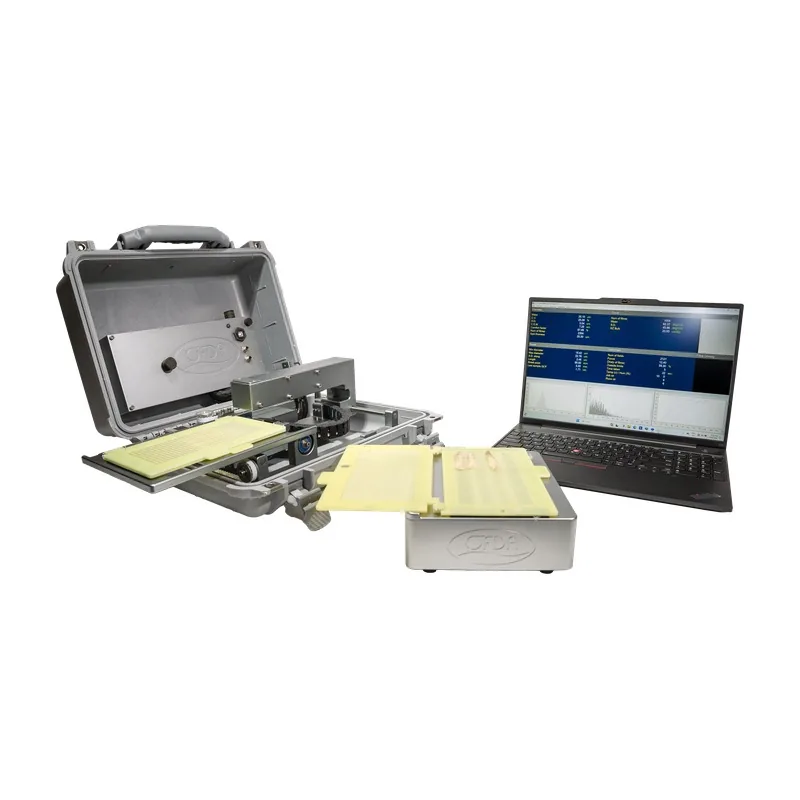
A documented, quality-controlled method

-
OFDA 2000, staple mode
Optical diameter measurement using an in-house method derived from IWTO-47, along the full length of the staple.
-
Herd correction factor
Samples are measured greasy; one sample from your herd is washed and measured again. The difference gives the factor applied to the whole batch.
-
Trim High
ON by default: fibres coarser than 80 µm (guard hair) are left out. OFF on request, and always for washed fibre.
-
Checks on every batch
Daily instrument self-test and a reference staple with every batch, as set out in our quality charter.
Internal metrology control programme - in-house method derived from IWTO-47.
What a report looks like
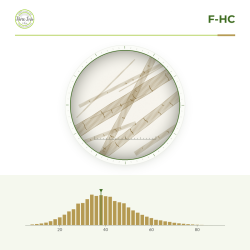
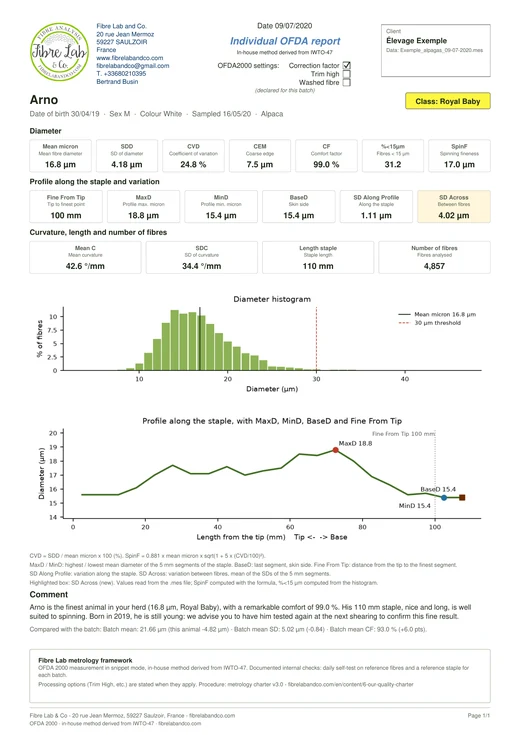
For each order: a 4-page summary for the batch (table of the 21 indicators, comparisons, distributions, micron by date of birth), plus one sheet per animal. Example taken from a real batch, with fictitious animal and farm names.
New at Fibre Lab & Co
A report that explains itself, with advice
Our PDF reports now include a plain-language description for each animal and for the whole herd, with advice on next steps at every analysis: what stands out in the batch, which animals to retest, what to focus on in your breeding. Included at no extra cost; you can untick it when ordering.
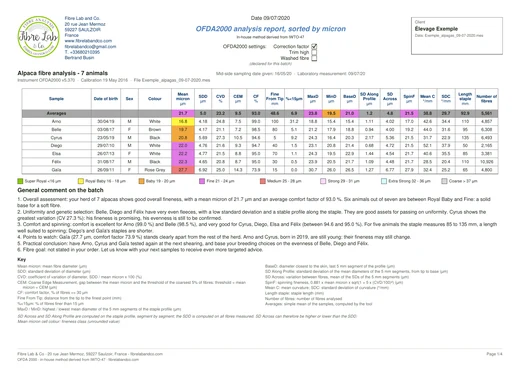
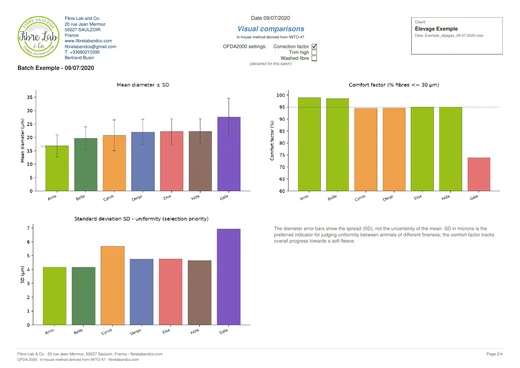
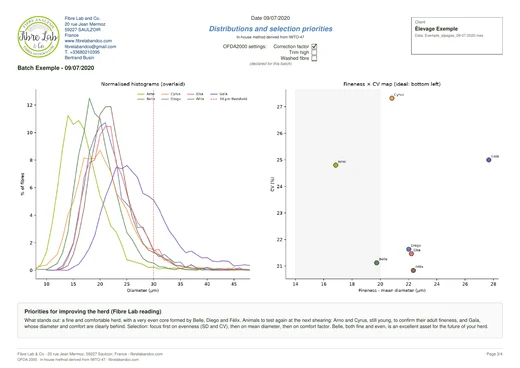
Click to enlarge
- 21 indicators: mean micron, SDD, CVD, CEM, CF, %<15 µm, spinning fineness, Fine From Tip, MaxD, MinD, BaseD, SD Along, SD Across, curvature and its SD, staple length, number of fibres, plus identification
- Diameter histogram with the 30 µm comfort threshold
- Along-staple profile (MaxD, MinD, BaseD, Fine From Tip), comment and batch benchmarks
- Fineness class for the species


Your results on Fibre Herd
Fibre Herd is the online register for your animals. With the full, washed fibre or uniformity analysis, results go straight to each animal's record, linked by its FLID (Fibre Herd Livestock ID): the animal's unique, permanent identifier that links its samples and analyses to its record.
Frequently asked questions
A small handful two fingers wide, i.e. about 5 cm, taken at mid-side and cut close to the skin.
No. Send it greasy: the lab calculates your herd correction factor, or washes each sample if you choose the washed fibre analysis.
Paper envelope or bag: paper lets the sample adjust to the temperature and humidity of the testing room. The OFDA 2000 corrects for temperature and humidity, provided the fibres are at the same temperature and humidity as the room at the time of testing: this is what makes the results accurate. No staples: so nobody gets hurt when opening it. No tape: fibres would stick to the tape when opened. One labelled envelope per sample: animal's name or number, to avoid mix-ups.
Yes, free of charge and within one week, on request by email with your order reference. See our quality charter
1 to 2 weeks after receipt, up to 1 month during shearing season.
Yes: tick "Return my samples" when ordering. €12 per order, whatever the number of animals.
Simple to sort, full to select, uniformity to assess an animal's whole fleece, yarn for a finished yarn, plant fibre for hemp and flax.
A question before ordering?
Write to us, we reply by email.
fibrelabandco@gmail.comFibre Lab and Co. - Bertrand BUSIN, 20 rue Jean Mermoz, 59227 Saulzoir, France