

Fill the information sheet (upload file below), send by email fibrelabandco@gmail.com and ship with samples to :
Fibre Lab and Co.
20 rue Jean Mermoz
59227 SAULZOIR
FRANCE
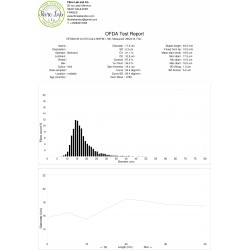
The report includes standard deviation, coefficient of variation of diameter, curvature, average diameter, spinning fineness, fibre length and comfort factor.
The report also includes histograms and “along fibre” micron profile graphs and summaries.
Single flat rate
The analysis report will be available for download as a PDF file in your customer account and will remain accessible at any time.
WHY HAVE YOUR FIBRE ANALYSED?
Fibre analysis is an essential tool for monitoring the progress of your breeding and selection programme.
It is an objective way to track changes in the individual characteristics of your animals.
It is important to remember that the analyses are relevant to your own herd. Fibre varies considerably depending on:
When should the sample be taken?
There are two options:
You can take it at shearing.
You can also take it before shearing.
In that case, you can be sure of sampling from the right place, and you will have the results before shearing so that you can sort fleeces according to their fineness.
How much fibre is needed for the analysis?
For each animal, take the equivalent of a handful (a small handful, about 5 cm wide) of fibre.
It can be useful to take two samples. That way, if there is a problem or if you want to retest a fleece, you have a backup.
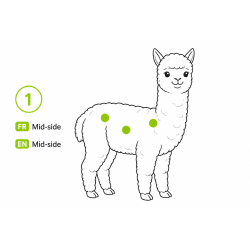
Where should I take the fibre sample?

Make sure you take the sample as close to the skin as possible.
Place each sample in an unsealed, unstapled paper envelope (no plastic).
Clearly write the name or number of the animal on the envelope.
IMPORTANT: Samples must be dry. Moisture can significantly distort the results.
Shipping instructions:
Clearly identify each envelope with the animal’s name and list number.
Group all envelopes, arranged in the order of your list, in the same parcel.
Please send us the summary spreadsheet by email, or print it and enclose it with the parcel.
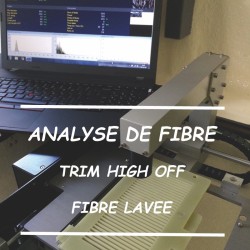
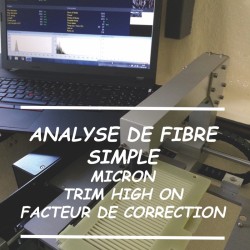
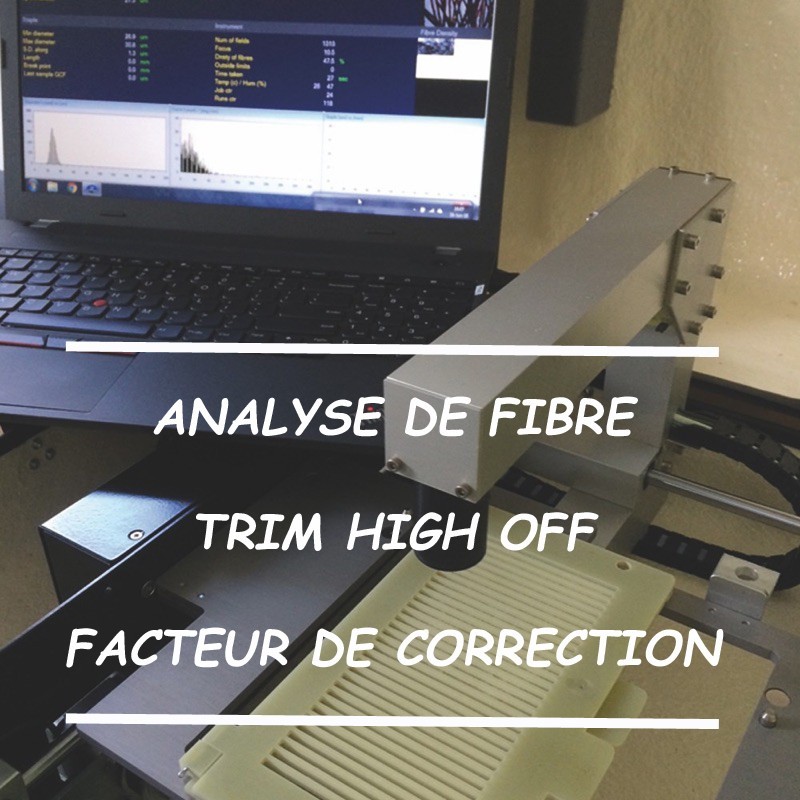
Measurement on the OFDA 2000 in staple mode, according to the recognised optical method IWTO-47. Documented internal checks every test day and for every batch. Fibre Lab is not an ISO/IEC 17025 accredited laboratory and does not hold an IWTO licence: rigor rests on the procedure below, not on an external label.
How we stand behind the result
A result is only meaningful if the process is the same from one batch to the next. Our charter describes that process.
Fill the information sheet (upload file below), send by email fibrelabandco@gmail.com and ship with samples to :
Fibre Lab and Co.
20 rue Jean Mermoz
59227 SAULZOIR
FRANCE